Category Archives: Traditional Catholic Values and Beliefs

Traditional Religious Orders on the Rebound

With the loss of so many vocations over the past fifty years, we’ve seen a general (and often severe) contraction of religious orders across the board. Every once in a while, however, you come across an account of a religious order that is actually growing, sometimes explosively so.

The Discalced Carmelites, however, are on the rebound.

Since 2000, the Carmelites have been faced with the sort of challenge many religious orders pine for: a boom in vocations. In that year, the nuns moved into the monastery at Elysburg, Pennsylvania from their original home in Nebraska, which they soon outgrew. They were thus granted permission to take over another declining Carmelite monastery, the Carmel of St. Joseph and St. Anne, in Philadelphia — and filled that one with vocations as well. So finally, with the community having overflowed its lodgings twice, the Carmelites received permission last summer from His Excellency Ronald Gainer, bishop of the Diocese of Harrisburg, to expand operations again, this time constructing a new monastery from the ground up.

According to their superior, Mother Stella, “I think the young women are drawn to beauty in the liturgy. They know that if God exists, if God is on our altars, if God is within the Holy Sacrifice of the Mass, then He needs to be worshiped as He deserves: with beauty and reverence,” she said of what she thinks draws young women to the Carmelites in particular. “They see that we have that here in our monastery, and they want to be a part of that. They also want something that is authentic, that goes back to the time of our holy mother, St. Teresa.”

Read the entire article here:
https://www.lifesitenews.co…

Did Pope Francis Wreck the Mass? No!

Three priests at altar performing New Mass. One has clown makeup.

The problems which plague the Catholic Church predate the rise of Bergoglio to the Chair of Peter by a generation at least.  Is the Latin Mass under threat?  Yes.  Is the Novus Ordo Mass beset with flaws and subject to all manner of abuse?  Yes.

Is it the fault of Pope Francis?  Nope.

Check out this very informative video by Michael J. Matt.  He lays out the problem very well…

It may not look like it, but we’re winning!

Recreational Vehicle with the words "The Traditional Roamin' Catholic"

From a vehicle storage lot in an unknown location, Henry (you can call him Hank) Igitur kicks off a new video series for CatholicCyber-Militia.com.

In his inaugural video, Hank gives a shout-out to the “scores” of subscribers (he’s an optimist, that Hank) and shares an article from Michael Matt.  What he doesn’t share is what may (or may not) be lurking in the contents of his coffee cup!

Like it?  Hate it?  Confused and/or bored by it?  Let us know what you think of this new feature!

The Sea Battle That Saved the West (Oh, yeah, and it was Catholics who fought it!)

The Battle of Lepanto (7 October 1571) was a naval engagement in the waters off southwestern Greece between the allied Christian forces of the Holy League and the Ottoman Turks during an Ottoman campaign to conquer the Venetian island of Cyprus.  The battle marked the first significant victory for a Christian naval force over a Turkish fleet and the climax of the age of galley warfare in the Mediterranean.

The above summary can be found at  Britannica.com .    What this secular article won’t tell you is that this victory was won (against pretty daunting odds) through prayer and the intercession of Our Lady.

Pope Pius V, a Dominican prelate before his elevation, did what Catholics have always done in times of acute danger: fly into the arms of the most powerful Mother of God. As a follower of Saint Dominic, he knew the most effective means of imploring her help was through the recitation of the Holy Rosary. He ordered all monasteries and convents in Rome to increase their prayers for the impending battle and organized rosary processions in which he, as sick as he was, participated.

As the Christian fleet sailed toward the great clash of cultures, Mass was celebrated and the rosary recited daily on each vessel. This heartfelt request for divine assistance resulted in a crushing defeat of the Ottomans at Lepanto that ended their dominance in the Mediterranean.  (Source:  TFP Student Action )

The battle of Lepanto is not well-known in the English speaking world, owing in no small part to the effects of the Black Legend.  Lepanto was fought during the reign of that anti-Catholic monster, bloody Queen Elizabeth I of England.  A victory by a Catholic fleet was not going to get much positive press in Elizabethan England!

A few centuries later, however, it was an Englishman who helped to set the record straight.  On the eve of World War I, G.K. Chesterton wrote what some consider to be the best English language poem of the 20th Century.  If you haven’t read or listened to his epic Lepanto, you really ought to!

Brandon Vought says the following of Lepanto:

The great G.K. Chesterton wrote a poem about these events, appropriately titled “Lepanto”, which I’ve enjoyed several times. I must say, after devouring all of Chesterton’s novels, poetry, short stories, and the majority of his essays, I think “Lepanto” is my favorite piece of his writing. I’m not alone. Hilaire Belloc, Chesterton’s good friend, considered “Lepanto” not only Chesterton’s greatest poem, but the greatest poem of their generation, staggering praise from the usually reserved historian.  (Source: https://brandonvogt.com/why-you-should-read-g-k-chestertons-lepanto-today/ )

The YouTube video below is a dramatic reading by Tom O’Bedlam of Chesterton’s Lepanto.  With all the nonsense our kids learn in so-called “Catholic” schools these days, if only a brief block of time could be set aside to teach them this piece of literature, how it would strengthen their faith!

G. K. Chesterton on the re-emergence of paganism in the West

Cover of the book "Heretics" by G. K. Chesterton. The cover shows a gargoyle from the Notre Dame Cathedral.

Great quote from the amazing G. K. Chesterton in his book Heretics

My objection to . . . the reassertors of the pagan ideal is, then, this. I accuse them of ignoring definite human discoveries in the moral world, discoveries as definite, though not as material, as the discovery of the circulation of the blood. We cannot go back to an ideal of reason and sanity. For mankind has discovered that reason does not lead to Chesterton Heretics Book Coversanity. We cannot go back to an ideal of pride and enjoyment. For mankind has discovered that pride does not lead to enjoyment. . . . If they like, let them ignore these great historic mysteries—the mystery of charity, the mystery of faith. . . . But if we do pursue, as a society, the pagan ideal of a simple and rational self-completion we shall end where Paganism ended. I do not mean that we shall end in destruction. I mean that we shall end in Christianity.
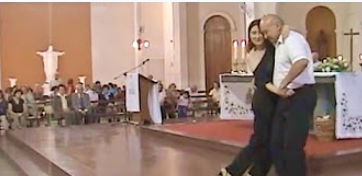
Liturgical Gimmickry

Balloon masses.

Clown masses.

Hootenanny/Rock Band/Jazz Band masses.

Liturgical dancing.

Not exactly the same image as the description of King David dancing before the Ark of the Covenant, is it?

And, unfortunately, guess who was presiding at the Mass?

Hey!  Liturgical “Innovators!”  Know what might be fun?  How ’bout doing a Mass where it is a supernatural event wherein God Himself is made present (Body, Blood, Soul and Divinity) among us?  And everyone actually behaves as if that’s really happening?  Wouldn’t that be a novelty?  Whadd’ya think?

Tango Mass2

Recent Entries »